
Updated Jul 29 2026
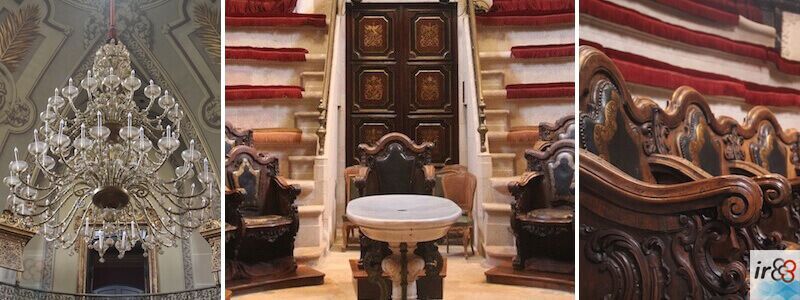
The Anatomical Amphitheatre of Barcelona is one of the most curious and remarkable features housed within the Royal Academy of Medicine of Catalonia (RAMC). All of this makes the guided tour one of the most surprising and fascinating experiences in Barcelona.
Visit to the Anatomical Amphitheatre of Barcelona and the Royal Academy of Medicine of Catalonia
Guided visit with audio guide in English
During the purchase process, in the “Discounts” section, select «irBarcelona» and enter your ID number in Card Number” to receive a 10 % discount, as shown in the image below.

Thus, during the visit, various interesting anecdotes are shared about the building and the institution, some of the illustrious figures who frequented it, as well as the precise workings and teaching process that took place there.
To get a full sense of all this, the excellent state of preservation of the amphitheatre—one of the most notable in Europe—helps enormously.
Information about the guided visit to the Anatomical Amphitheatre of Barcelona and the RAMC
The Royal Academy of Medicine of Catalonia, and consequently the historic Anatomical Amphitheatre, can be visited through the guided tours that are organised. These guided tours are conducted in Catalan, although audio guides in Spanish and other languages are made available to all visitors.
Wednesdays and Saturdays: 10:30, 11:30 and 12:30.
€ Price: €14 (10% discount by selecting the “irBarcelona” discount during the purchase process).
Guided tour language: Spanish and Catalan.
Audio guide languages: Spanish, Catalan, English, French, German, Russian and Chinese.
* On some Fridays, a special tour is organised which, in addition to the guided tour, includes a glass of cava and a magic show. The duration of this tour is 1 hour 45 minutes and the price is higher.
It is not necessary to book online to take the tour, but it is recommended, as this way you can benefit from a 10% discount by selecting “irBarcelona” in the “Discount” options that appear during the purchase process.
Despite being one of the most charming places in Barcelona, whose visit offers a firsthand insight into both a fascinating past era of the city and, more specifically, the history and development of medicine in Catalonia and the rest of Spain, the Royal Academy of Medicine of Catalonia remains one of those hidden gems in Barcelona still waiting to be discovered by many Barcelonians.
We hope that, after reading this article, we have sparked your desire to visit this unique space located in the Raval neighbourhood, specifically in one of the buildings of the former Hospital de la Santa Creu in Barcelona.
History of the Royal Academy of Medicine of Catalonia building
The building that houses the Royal Academy of Medicine of Catalonia, and in one of its rooms contains the 18th-century Anatomical Amphitheatre of Barcelona, is part of the complex of the former Hospital de la Santa Creu in Barcelona. This hospital was operational for six centuries, from 1401 until 1929, when it became the Hospital de la Santa Creu i Sant Pau and moved to the new Eixample District.
The building is an extension of the hospital complex, designed to provide space for a new institution, the Royal College of Surgery of Barcelona. It was constructed by the architect Ventura Rodríguez using stone from the Montjuïc hill in what was, at the time, a somewhat novel and restrained neoclassical style.
Even so, the building also features some Baroque architectural details, more typical of the period in which it was designed. After two years of work, the building was inaugurated in 1764.
The Royal College of Surgery of Barcelona, whose members worked and taught in the Anatomical Amphitheatre, was transformed into the Faculty of Medicine in 1843.
However, it was not until a few years later, specifically in 1907, that, taking advantage of the opening of the Clinical Hospital, it moved to much larger and more modern facilities in the new hospital.
Finally, in 1929, the building was handed over to the Barcelona Academy of Medicine, the current Royal Academy of Medicine of Catalonia.
All the information about the history of the Anatomical Amphitheatre of Barcelona
The Anatomical Amphitheatre of Barcelona, like the building in which it is located, dates back to the 18th century and was designed to provide the recently established Royal College of Surgery of Barcelona with a space in which to carry out its work.
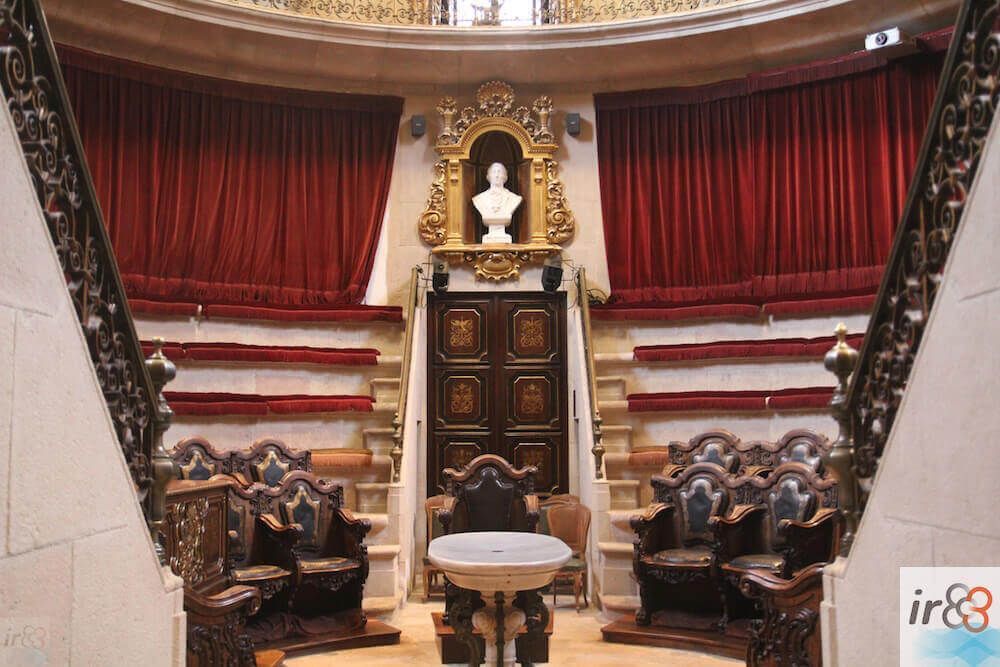
The amphitheatre, circular in shape and featuring a dome whose walls commemorate some of the most illustrious figures of the RAMC, is topped by a magnificent and spectacular chandelier. At the centre of the anatomical amphitheatre stands an original marble table on which human dissections for scientific purposes were conducted.
Thus, the professor in charge of conducting the task would position himself at the centre, next to the marble table on which the cadaver or anatomical specimens were placed, while the students observed and took notes from the seats.
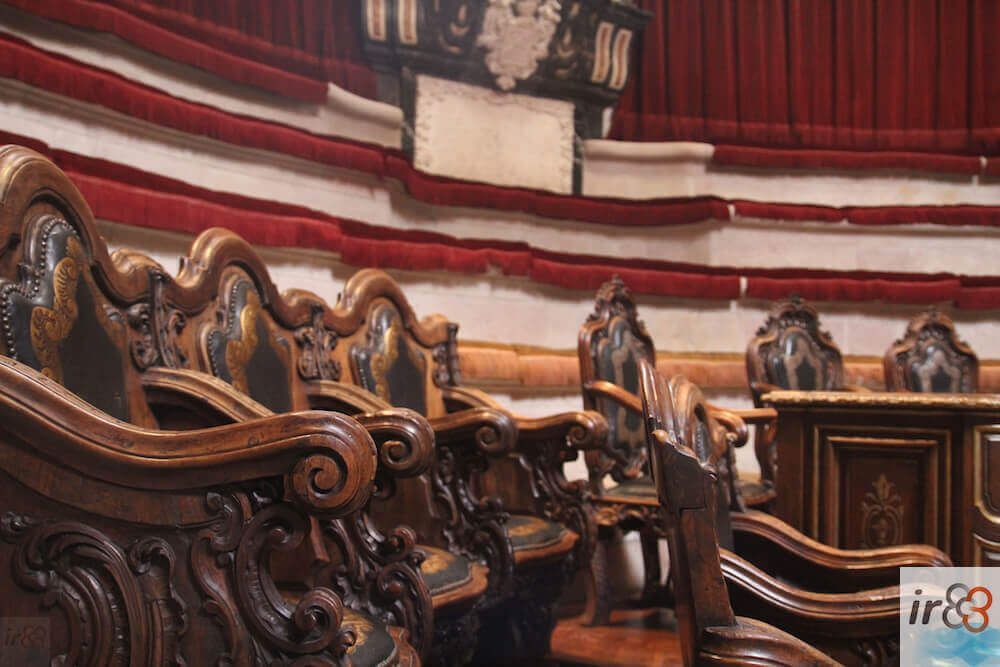
These seats, made of wood and carved in the Rococo style by the skilled hands of craftsman Llorenç Rosselló, are another of the amphitheatre’s outstanding features.
Santiago Ramón y Cajal and Other Distinguished Figures at the RAMC
Throughout its history, the Royal Academy of Medicine of Catalonia, although known under different institutional names, has counted academics and collaborators of great significance.
Among them, perhaps the best-known is Santiago Ramón y Cajal, Professor at the Faculty of Medicine and recipient of the Nobel Prize in Physiology or Medicine in 1906, thanks to his studies on the structure of the nervous system.
Other notable figures closely associated with the building or the institution include Pere Virgili, Antoni de Gimbernat, Miguel Servet, and Pere Mata i Fontanet.
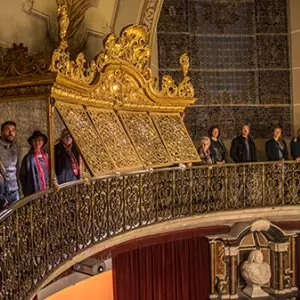
Not all attendees of these dissections and human anatomy classes were students, which is why a space at the upper level was adapted. From there, and thanks to a lattice screen, occasional attendees, sometimes including prominent members of Barcelona’s most important families, could satisfy their curiosity without the risk of being seen.
Where is the Anatomical Amphitheatre of Barcelona? Map and how to get there
Address
c/ (street) del Carme, 47, Barcelona.
Opening hours
The information is provided above.
Admission
Free.
How to get there?
Metro: Catalunya (lines 1 and 3), Liceu (line 3) and Universitat (lines 1 and 2).
Buses: Lines 7, 9, 13, 14, 16, 17, 20, 24, 37, 41, 42, 50, 54, 55, 58, 59, 62, 63, 64, 66, 67, 68, 91, 120, 121, 141, H12 and the Tourist Bus.
Renfe and FGC: Catalunya.
By foot: Right in the centre of Barcelona and just a few steps from La Rambla, the Royal Academy of Medicine of Catalonia can easily be reached if you are in El Raval quarter or in the Barcelona Gothic quarter.
Nearby places of interest
Biblioteca Nacional de Catalunya
Barcelona Museum of Contemporary Art
Barcelona Centre of Contemporary Culture
La Rambla of Barcelona
La Boqueria Market